The Prime Minister of India heads the Union Government. He/she is also an extremely crucial constitutional authority within India. As Prime Minister, he/she leads the Council of Ministers; directs government policy; makes critical administrative decisions; and represents India at international conferences.
The amount of money the Prime Minister of India receives each month and the types of facilities that are available to him/her have many people interested. In India, the PM’s salary is comprised of a monthly base salary, an expense allowance (sumptuary) and a constituency allowance. Additionally, the PM receives daily allowances according to current government regulations.
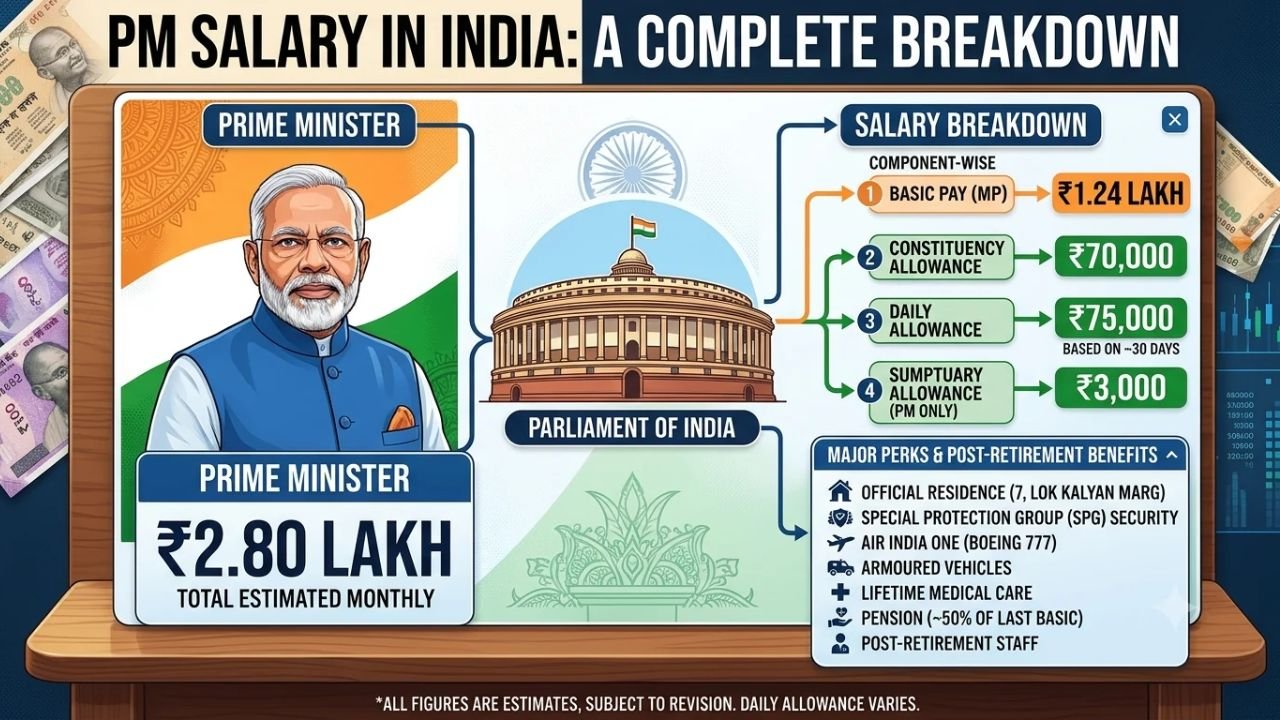
The Prime Minister gets paid an annual salary of 1,24,000 INR based on the current revised pay structure. He also gets 3,000 INR per year in sumptuary allowance, along with 87,000 INR per year for his constituency allowance.
Therefore, the fixed monthly component is Rs. 2,14,000, not including applicable daily allowances. In addition to monetary compensation, the Prime Minister has a formal residence, security, government transport, access to healthcare and clerical help.
This article provides an explanation of the Prime Minister’s monthly wage, yearly earnings, additional benefits (allowances), access to governmental services/facilities and other relevant information.
PM Salary in India 2026: Overview
Here is a quick overview of the Prime Minister’s salary and benefits in India.
| Particulars | Details |
| Position | Prime Minister of India |
| Basic monthly salary | ₹1,24,000 |
| Sumptuary allowance | ₹3,000 per month |
| Constituency allowance | ₹87,000 per month |
| Fixed monthly components | ₹2,14,000 |
| Daily allowance | ₹2,500 per eligible day |
| Official residence | 7, Lok Kalyan Marg, New Delhi |
| Security | Special Protection Group (SPG) |
| Medical facilities | Government-supported facilities |
| Official transportation | Specially secured government vehicles and aircraft |
| Salary structure | Based on parliamentary and ministerial laws |
Note: The figures above reflect the latest available revised rates applicable from 1 April 2023. Daily allowances are not fixed monthly payments.
What Is the Monthly Salary of the Prime Minister of India?
The Prime Minister’s salary is determined under the Salaries and Allowances of Ministers Act, 1952. According to this legislation, ministers receive a salary and daily allowance at the rates applicable to Members of Parliament. They are also entitled to a constituency allowance.
The Prime Minister receives the following monthly payments:
| Salary Component | Monthly Amount |
| Basic salary | ₹1,24,000 |
| Sumptuary allowance | ₹3,000 |
| Constituency allowance | ₹87,000 |
| Total | ₹2,14,000 |
Thus, the fixed monthly salary components of the Prime Minister amount to approximately ₹2.14 lakh.
The daily allowance of ₹2,500 is separate and is payable according to the applicable rules and eligible days. It should not be added as a guaranteed monthly amount.
PM Salary in India Per Year
The annual salary of the Prime Minister can be calculated by multiplying the monthly fixed salary components by 12.
The following table explains the annual calculation.
| Salary Component | Monthly Amount | Annual Amount |
| Basic salary | ₹1,24,000 | ₹14,88,000 |
| Sumptuary allowance | ₹3,000 | ₹36,000 |
| Constituency allowance | ₹87,000 | ₹10,44,000 |
| Total | ₹2,14,000 | ₹25,68,000 |
Based on these components, the Prime Minister receives fixed annual compensation of approximately ₹25.68 lakh.
Daily allowances and other eligible official travel entitlements are additional. The amount actually received may differ depending on applicable rules and deductions.
Different Allowances Given to the Prime Minister of India
The Prime Minister receives several other types of payments in addition to their regular monthly income. Government laws provide for these payments to assist the Prime Minister in performing his/her job-related duties and tasks.
1. Basic Salary
The fixed amount of money that is paid each month to the Prime Minister for being the leader of the government is referred to as his/her basic salary.
The current monthly basic salary is ₹1,24,000. This is based on the salary scale used for members of parliament.
The fundamental part of the Prime Minister’s total monthly pay includes his/her base wage.
2. Sumptuary Allowance
The Prime Minister receives a sumptuary allowance of ₹3,000 per month.
The provision of this allowance is made by virtue of section 5 of the Salaries and Allowances of Ministers Act, 1952. The purpose of this allowance is to assist in meeting the costs of entertaining guests in connection with the performance of ministerial duties.
An allowance is separate from a base salary and will be received as a separate payment.
3. Constituency Allowance
The Prime Minister also receives a constituency allowance of ₹87,000 per month.
This allowance is provided to cover expenses associated with being an MP. This includes supporting responsibilities as a constituency representative and communicating with the public.
The amount was revised from ₹70,000 to ₹87,000 with effect from 1 April 2023.
4. Daily Allowance
The daily allowance is also an essential part of the Prime Minister’s total compensation.
The daily allowance for each member of Parliament (MP) was increased from ₹1,000 to ₹2,500 for each day that an MP can claim a daily allowance. MPs who are also ministers will continue to receive their daily allowances in accordance with the relevant sections of the Salaries and Allowances of Ministers Act.
The allowance is based on eligibility and other rules. However, the allowance does not guarantee you an additional amount each month.
5. Official Travel Allowance
The Prime Minister travels throughout India and around the world on official business for various purposes, including attending government sponsored activities, official diplomatic meetings and other significant events.
Under the provisions of the ministerial salary law, the Prime Minister is eligible for travel and per diem expenses while on official business trips, as determined by Government regulations.
These arrangements help manage travel expenses associated with official duties.
Facilities and Benefits Received by the Prime Minister of India
In addition to his monthly salary and benefits, the Prime Minister has access to many other government services. These additional services help him carry out his duties as a leader and protect him.
1. Official Residence
During their time in office, the Prime Minister will be provided with a fully-furnished government-owned residence free of charge.
The official home of the Prime Minister can be found at 7, Lok Kalyan Marg, New Delhi.
The home is equipped with a space to hold official meetings, perform administrative tasks, provide security, and house people.
The Ministers’ Salaries and Allowances Act, 1952, provides ministers with an unfurnished residence for the duration of their time in office.
2. Security Facilities
Security is one of the most important facilities provided to the Prime Minister.
The current Prime Minister has the Special Protection Group (SPG) provide him with close protection. This is an organization that provides specialized security to the Prime Minister.
Official programs, public appearances, travels, and major events are all protected by the security measures in place.
The amount of protection that will be provided depends upon what responsibilities are required for the job as well as how much security is needed to perform those responsibilities.
3. Official Transportation
The Prime Minister uses vehicles with special security measures for official travel.
These vehicles have state-of-the-art security features that are used at all times for public events, formal meetings and domestic trips.
For international travel, specifically configured government planes, such as Air India One, are utilized during critical official travels.
The transportation facilities are provided to ensure safe and efficient travel.
4. Medical Facilities
The Prime Minister is eligible for medical care provided by the Government, as per existing policies.
These facilities provide an opportunity to obtain medical treatment and health care services as needed.
The medical provisions are separate from the Prime Minister’s monthly salary.
5. Administrative Staff
The Prime Minister has administrative support provided by staff members of the Prime Minister’s Office.
The PMO is a key player in managing all of the different types of government business, including communications, official meetings, policies, etc.
The staff handles managing appointments, documenting work, and handling other office-related administrative tasks.
6. Official Travel and Accommodation
The Prime Minister makes frequent visits to various states and countries on official business and at diplomatic gatherings.
The government will provide you with the required transportation, lodging and other travel accommodations while on official tour, based upon current applicable regulations.
The Prime Minister’s ability to fulfill both national and international duties is enhanced by these facilities.
Who Decides the Salary of the Prime Minister of India?
The salary of the Prime Minister is governed by laws passed by Parliament.
The Indian Constitution gives Parliament the authority to pass legislation concerning the payment of ministers’ salaries, allowances and other forms of compensation.
Two important laws are associated with the Prime Minister’s salary structure.
This is a law which determines what the Prime Minister, and all other ministers will be paid in terms of salary, daily allowances, money for their constituencies, housing, etc.
Salary, allowances and pensions of Members of Parliament Act 1954: This legislation determines the salary and allowances of Members of Parliament. Rates determined by this Act are also used to determine the salary and allowances of Ministers pursuant to the 1952 Act.
The government has the ability to adjust all salaries and allowances that apply to its employees, by utilizing the formal legal notice procedures.
How Has the Prime Minister’s Salary Changed Over the Years?
The pay structure for the prime minister has evolved throughout history as a result of changes made to the salaries and benefits paid out to members of parliament.
As the Prime Minister’s base pay is tied to that of Members of Parliament, changes to MP salaries will result in changes to the Prime Minister’s base pay.
Some important salary revisions are given below:
| Period | Monthly Basic Salary of MPs |
| Before 2009 revision | ₹16,000 |
| 2009 onwards | ₹50,000 |
| April 2018 onwards | ₹1,00,000 |
| April 2020–March 2021 | ₹70,000 |
| April 2021–March 2023 | ₹1,00,000 |
| April 2023 onwards | ₹1,24,000 |
A one-year, temporary 30 percent cut was put into place on the salary of members of parliament and some ministerial allowances on April 1, 2020 during the COVID-19 pandemic.
After the temporary reduction ended, the earlier salary rates were restored.
The most recent update raised MPs’ monthly base pay to ₹1,24,000, and their per diem rate to ₹2,500 on April 1, 2023.
Difference Between the Salary of the Prime Minister and President of India
The President and Prime Minister are two important constitutional authorities in India. However, their responsibilities and salary structures are different.
The President is the constitutional head of the country, while the Prime Minister leads the government and heads the Council of Ministers.
Here is a basic salary comparison:
| Position | Monthly Basic Salary |
| President of India | ₹5,00,000 |
| Vice President of India | ₹4,00,000 |
| Prime Minister of India | ₹1,24,000 |
The Prime Minister also receives applicable monthly allowances, which increase the total fixed monthly compensation to ₹2.14 lakh.
The President’s and Vice President’s salary structures are governed by separate legislation.
What Happens to the Prime Minister’s Salary After Leaving Office?
When a Prime Minister leaves their post, they will no longer receive their salary and other benefits.
On the other hand, the person may be entitled to some of the same benefits that former MPs receive as long as they have served as a Member of Parliament and follow the appropriate regulations.
A member who has been in Parliament for at least five years will receive a monthly pension of Rs 31,000 under the revised pension scheme. He/she may also receive a further sum of Rs 2,500 each month for each additional year of qualifying service in Parliament.
Former Prime Ministers are entitled to some degree of protection based on relevant government regulations.
It should be understood that the retirement and mailing services provided to you are distinct from your compensation for being the prime minister.
Why Does the Prime Minister Receive an Official Residence and Security?
The Prime Minister makes key government decisions, administers the country and represents it internationally.
The job requires many times in front of people, formal meetings and trips throughout the country.
An official home provides security for the Prime Minister to live and work in, and to hold meetings. Special security measures also protect the Prime Minister while performing official duties.
In addition to government transportation and administrative assistance, the Prime Minister has access to resources that allow him/her to fulfill their official duties without undue difficulty.
The purpose of these facilities is to allow the office to function efficiently and are not intended to represent an increase in your salary.
Conclusion
The PM’s salary is made up of his/her basic salary, along with various other ministerial and parliamentary benefits. According to the most recent revisions, the Prime Minister has a basic monthly salary of ₹1.24 lakh, a sumptuary allowance of ₹3,000, and a constituency allowance of ₹87,000.
The fixed monthly salary will be ₹2.14 lakh per month (excluding any applicable daily allowances). In total, the fixed portion of your salary for the year will be approximately ₹25.68 lakh.
The Prime Minister has numerous additional benefits, such as an official residence, protective services, transport, medical care and clerical support.
The purpose of these arrangements is to allow the Prime Minister to carry out his/her role of being the head of state for India both within the country and around the world.
Read Also: UP PGT Teacher Salary || UP TGT Teacher Salary || IBPS RRB Clerk Salary
Frequently Asked Questions
1. What is the PM salary in India per month?
The basic monthly salary of the Prime Minister of India is ₹1,24,000. The Prime Minister also receives a ₹3,000 sumptuary allowance and an ₹87,000 constituency allowance. The fixed monthly components total ₹2,14,000.
2. What is the annual salary of the Prime Minister of India?
The annual value of the Prime Minister’s basic salary is ₹14.88 lakh. Including the sumptuary and constituency allowances, the fixed annual compensation amounts to ₹25.68 lakh.
3. Does the Prime Minister of India receive a pension?
A former Prime Minister may qualify for a parliamentary pension based on applicable rules for former Members of Parliament and qualifying parliamentary service.
4. Does the Prime Minister pay rent for the official residence?
No. The Salaries and Allowances of Ministers Act, 1952, provides ministers with a furnished residence without rent during their term of office.
5. What is the daily allowance of the Prime Minister?
The revised daily allowance is ₹2,500 per eligible day under the applicable parliamentary and ministerial rules.